Back to Blog
Profile Growth
LinkedIn Profile Headline Examples That Get Noticed
Discover linkedin profile headline tips, proven examples, and formulas to attract recruiters, clients, and better opportunities today.
Admin 0 views📖 15 min read
LinkedIn Profile Headline Examples That Get Noticed
Your LinkedIn profile headline is one of the first things recruiters, clients, hiring managers, and potential collaborators see. If it only says your job title and company, you are wasting high-value profile space.
A strong headline helps you do three things fast:
- show people what you do
- help LinkedIn understand which searches you belong in
- give someone a reason to click your profile instead of the next one
For students, job seekers, freelancers, and working professionals, this matters more than ever. LinkedIn is crowded, attention is short, and vague headlines disappear. The good news: you do not need to be a copywriter to write a headline that works.
In this guide, LinkForge breaks down what makes a high-performing LinkedIn profile headline, shares proven formulas, and gives you headline examples for different career stages and goals. We also cover the mistakes competitors often gloss over, like keyword stuffing, weak positioning, and headlines that sound “inspiring” but say nothing.
“LinkedIn Recruiter is a pivotal tool for talent acquisition.” - Source
“A comprehensive and up-to-date profile serves as a trust signal, encouraging more interactions and responses.” - Source
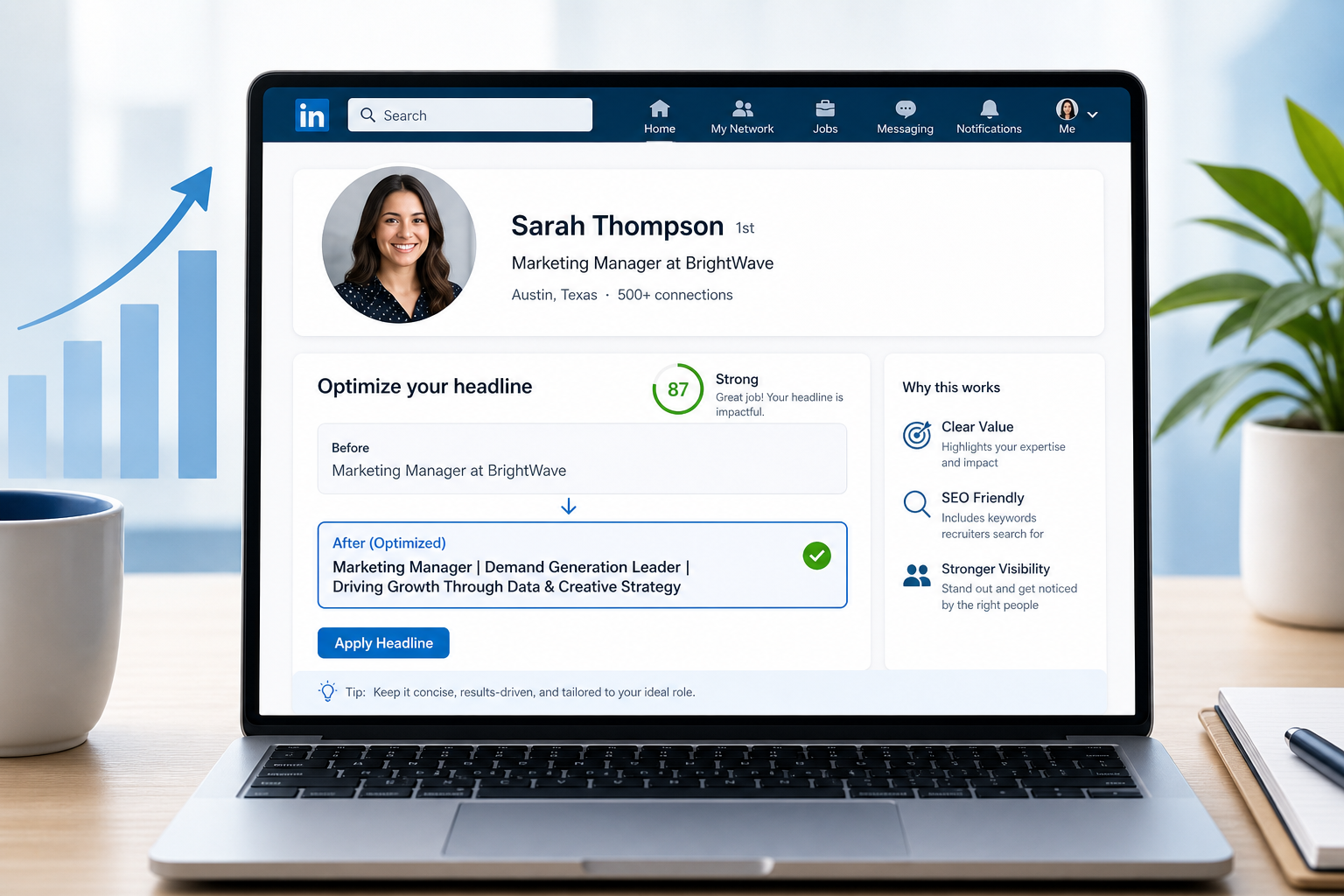
Why your LinkedIn profile headline matters so much
Your headline appears across LinkedIn in places where people decide whether to click:
- search results
- comments
- connection requests
- messages
- post feeds
- profile previews
That means your headline is not just a bio line. It is a visibility asset and a conversion asset.
A good headline can help you:
Many top-ranking articles mention job titles, keywords, and accomplishments. That is useful, but incomplete. What they often miss is that the best headline is not only descriptive. It is also strategic. It should reflect your goal: getting hired, winning clients, building authority, or changing careers.
What makes a great LinkedIn profile headline
The strongest headlines usually combine these four elements:
1. Your target role or professional identity
This tells people what lane you are in.
Examples:
- Product Designer
- Data Analyst
- Freelance Copywriter
- Sales Manager
- Marketing Student
- COO
2. High-intent keywords
These are the terms recruiters, clients, or collaborators are actually searching for.
Examples:
- SEO
- B2B SaaS
- Python
- Demand Generation
- Financial Modeling
- UX Research
3. A differentiator
This gives your headline personality without becoming vague.
Examples:
- helping startups scale
- healthcare-focused
- ex-agency
- certified PMP
- multilingual
- creator-led brands
4. Proof or outcome
This turns your headline from generic to credible.
Examples:
- Grew pipeline by 42%
- Built apps used by 100K+ users
- Helped 50+ founders refine positioning
- Reduced churn by 18%
- Dean’s List | Internship at XYZ
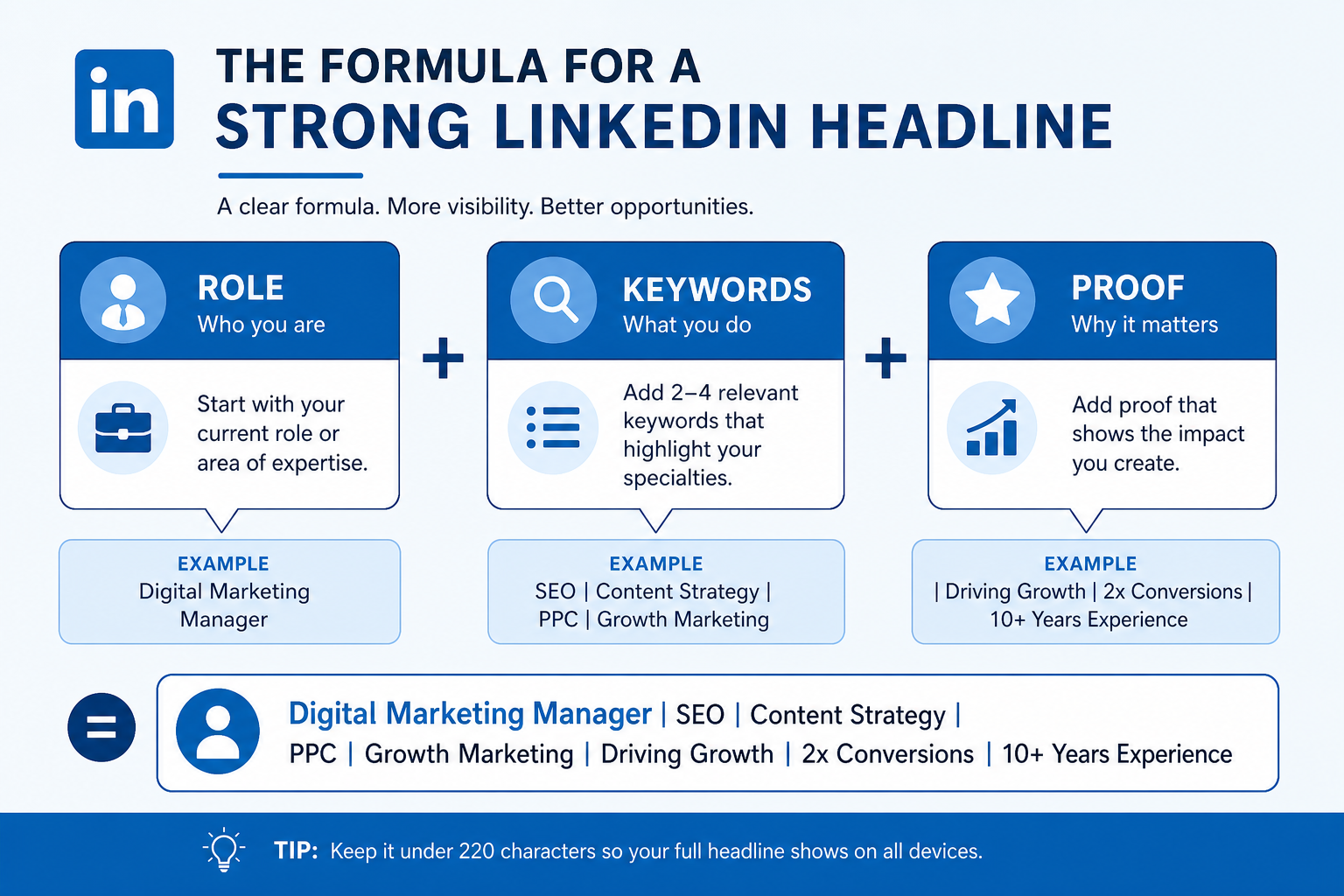
The simplest formula to use
Most people do best with this structure:
Role + keywords + proof/value
For example:
- Content Strategist | SEO, B2B SaaS, Thought Leadership | Helped brands grow organic traffic
- Financial Analyst | Forecasting, Excel, FP&A | Supporting data-driven decisions
- Freelance Graphic Designer | Brand Identity, Social Media, Packaging | Helping small brands look enterprise-ready
7 rules for writing a LinkedIn headline that gets noticed
Be clear before being clever
A creative phrase means nothing if no one understands what you do. “Growth wizard” is weaker than “Growth Marketer | Paid Social, CRO, Lifecycle Email.”
Lead with what you want to be known for
If you want product roles, lead with product. If you want freelance clients, lead with the service you sell.
Use searchable language
Use words people actually type into LinkedIn search, not internal jargon or invented branding.
Include specific skills, not soft fluff
“Strategic thinker” is weak.
“SQL, Tableau, Revenue Analytics” is useful.
Add proof when you can
Even one strong metric or result can improve credibility.
Match your current goal
Your headline should support your next step, not just describe your past.
Keep it readable
Use separators like | or • so your headline is easy to scan.
What to avoid in your LinkedIn profile headline
A lot of headlines fail because they are too vague or too self-focused.
Avoid:
- “Passionate about helping people succeed”
- “Results-driven leader”
- “Open to work”
- “Experienced professional”
- “Empowering transformation through innovation”
- excessive emoji use
- keyword stuffing with no clear message
These phrases either say too little, sound generic, or waste space that could be used for relevant search terms and value.
Headline templates you can adapt quickly
Use these as plug-and-play frameworks.
Template 1: Standard professional
[Target Role] | [Core Skill 1], [Core Skill 2], [Core Skill 3] | [Result or niche]
Template 2: Job seeker
Aspiring [Target Role] | [Relevant tools/skills] | [Internship, project, certification, or measurable proof]
Template 3: Freelancer or consultant
[Service Provider Title] | Helping [Audience] with [Outcome] | [Specialty]
Template 4: Career changer
[Target Role] | Background in [Previous Field] | [Transferable Skills] | [Relevant result/certification]
Template 5: Executive
[Executive Title] | [Business function] | [Growth, transformation, operations, or leadership outcome]
LinkedIn profile headline examples by audience
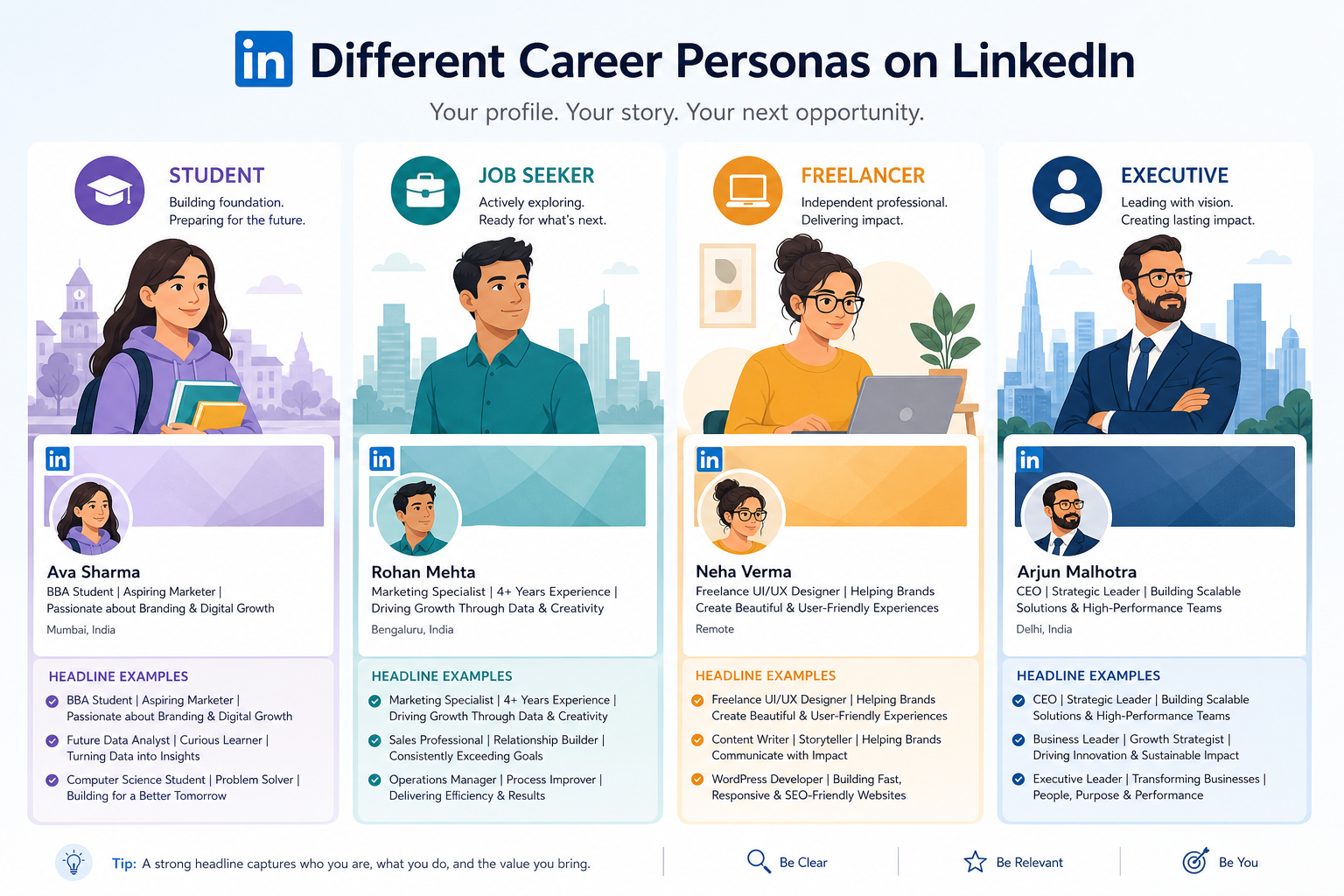
LinkedIn profile headline examples for students
Students often think they have “nothing to say” yet. Not true. You can use your degree, projects, campus roles, tools, and internships.
Examples
- Marketing Student | Social Media, Content Creation, Canva | Campus Ambassador with 10K+ campaign reach
- Computer Science Student | Python, Java, Machine Learning | Built a recommendation engine as capstone project
- Finance Undergraduate | Excel, Valuation, Financial Modeling | Treasurer, Student Investment Club
- Psychology Student | Research, Data Collection, Behavioral Analysis | Research Assistant in cognitive lab
- Engineering Student | CAD, SolidWorks, Prototyping | Robotics Club Lead | Internship experience
- Business Student | Market Research, PowerPoint, Excel | Startup internship and student leadership experience
LinkedIn profile headline examples for recent graduates
For recent grads, combine your target role with proof from projects, internships, certifications, or outcomes.
Examples
- Junior Data Analyst | SQL, Excel, Tableau | Built dashboards that improved reporting speed
- Entry-Level Software Engineer | JavaScript, React, APIs | Internship experience and production-ready projects
- Digital Marketing Graduate | SEO, Email, Social Media | Internship at agency with campaign reporting experience
- Financial Analyst | Forecasting, Excel, Budgeting | Internship at investment firm
- UX Designer | Figma, Wireframing, User Research | Portfolio with mobile and SaaS case studies
- Operations Analyst | Process Improvement, Reporting, Excel | Business degree with internship experience
LinkedIn profile headline examples for job seekers
If you are unemployed, do not make the headline about being unemployed. Focus on the role you want and the value you bring.
Examples
- Project Manager | Agile, Stakeholder Management, Process Improvement | Delivered cross-functional initiatives on time
- Customer Success Manager | Onboarding, Retention, SaaS Support | Built strong client relationships and renewal growth
- HR Generalist | Recruiting, Onboarding, Employee Relations | Supporting better hiring and retention
- Sales Development Representative | Prospecting, Outreach, CRM | Consistently exceeded pipeline goals
- Content Writer | SEO, Blogs, B2B Content | Creating content that drives traffic and trust
LinkedIn profile headline examples for career changers
Career change headlines work best when they highlight transferable skills and your target direction.
Examples
- Product Manager | Former Operations Lead | Process Design, Stakeholder Alignment, Roadmap Execution
- UX Researcher | Background in Psychology | Interviews, Insight Synthesis, User Behavior Analysis
- Digital Marketer | Former Sales Professional | Lead Generation, Copywriting, Funnel Optimization
- Data Analyst | Ex-Finance Professional | Excel, SQL, Reporting, Business Insights
- Instructional Designer | Former Teacher | Curriculum Design, Engagement, Learning Outcomes
LinkedIn profile headline examples for freelancers
Freelancers need headlines that tell prospects what they do, who they help, and why they are worth contacting.
Examples
- Freelance Copywriter | Helping SaaS brands improve conversion with landing pages, emails, and website copy
- Graphic Designer | Brand Identity, Packaging, Social Assets | Helping small businesses look premium
- LinkedIn Ghostwriter | Personal Branding, Thought Leadership, Content Strategy | Helping founders show up consistently
- Virtual Assistant | Inbox, Calendar, Admin Systems | Helping busy founders stay organized
- Web Designer | Shopify, Webflow, UX | Building high-converting websites for service brands
- Video Editor | Short-Form Content, Reels, YouTube | Editing for creators and coaches
LinkedIn profile headline examples for working professionals
These examples work well for people already employed who want more visibility, stronger positioning, or better future opportunities.
Examples
- Senior Account Manager | Client Growth, Retention, B2B Partnerships | Expanding strategic accounts
- Operations Manager | Process Improvement, KPI Reporting, Team Leadership | Driving efficiency at scale
- Software Engineer | Full-Stack Development, React, Node.js | Building reliable user-focused products
- Marketing Manager | Demand Generation, Campaign Strategy, Analytics | Leading growth across channels
- Business Analyst | SQL, Requirements Gathering, Dashboards | Translating data into action
- HR Business Partner | Workforce Planning, Coaching, Change Management | Supporting business growth through people
LinkedIn profile headline examples for executives
Executives should focus less on task keywords and more on scope, leadership, growth, transformation, and business outcomes.
Examples
- Chief Marketing Officer | Brand, Demand Gen, GTM Strategy | Scaling revenue and market presence
- VP of Operations | Process Transformation, P&L, Team Leadership | Driving operational excellence across regions
- Chief People Officer | Talent Strategy, Culture, Organizational Design | Building high-performing teams
- COO | Systems, Scale, Execution | Turning growth strategy into operational results
- CEO | SaaS, Product-Led Growth, Partnerships | Building and scaling category-focused companies
- CFO | FP&A, Capital Planning, Business Strategy | Supporting sustainable, data-led growth
Best LinkedIn headline examples by industry
Marketing
- Growth Marketer | Paid Social, CRO, Lifecycle Email | Driving measurable acquisition
- Content Strategist | SEO, Editorial Planning, B2B SaaS | Building content engines that rank and convert
Sales
- Account Executive | Enterprise SaaS, Consultative Selling, Pipeline Growth | Closing strategic deals
- SDR | Prospecting, Cold Outreach, CRM | Building qualified pipeline consistently
Tech
- Front-End Developer | React, TypeScript, UI Performance | Building fast, intuitive web experiences
- Data Scientist | Python, Machine Learning, Forecasting | Turning data into business decisions
Finance
- Financial Analyst | FP&A, Forecasting, Excel | Supporting smarter planning and reporting
- Investment Associate | Valuation, Due Diligence, Market Analysis | Focused on growth opportunities
HR
- Talent Acquisition Specialist | Tech Recruiting, Sourcing, Interview Coordination | Connecting strong talent with the right roles
- People Operations Manager | Onboarding, Compliance, Engagement | Creating smooth employee experiences
Consulting
- Management Consultant | Strategy, Operations, Change | Helping teams improve performance
- Fractional COO | Systems, Process, Team Enablement | Helping founders scale operations
Before-and-after headline examples
Here is where many people improve fast.
How to write a headline for your specific goal
If you want a new job
Lead with the job title you want, then add searchable skills and proof.
If you want freelance clients
Lead with your service and audience. Make the outcome obvious.
If you want more networking opportunities
Use a headline that makes your niche and interests clear enough for the right people to connect.
If you are building a personal brand
Mix role, niche, and point of view without sacrificing clarity.
A quick 5-step process to create your best headline
Step 1: Pick your target
Ask: what do I want this headline to help me do?
Step 2: List 5 to 10 keywords
Write down your role, tools, specialties, industries, and strengths.
Step 3: Add one credibility marker
This could be a metric, certification, employer type, portfolio, client category, or project.
Step 4: Draft 3 versions
Try:
- keyword-first
- value-first
- proof-first
Step 5: Choose the clearest one
If a stranger can understand it in five seconds, you are close.
A practical headline worksheet
Use this mini exercise:
How LinkForge helps you write a better LinkedIn profile headline faster
Most people do not need more theory. They need a faster way to turn messy ideas into a polished headline they can use now.
That is exactly where LinkForge fits.
LinkForge gives professionals access to 40+ LinkedIn-focused tools in one place, built for profile optimization, content creation, outreach, and job search organization. It is designed for people who want strong results without subscriptions, friction, or privacy concerns.
Why LinkForge is different
- 100% free forever
- no sign-up or registration required
- no personal data collected
- tools run locally in your browser
- instant, professional-quality outputs
- built specifically for LinkedIn optimization
- export-friendly workflows including PDF and PNG
- works across mobile, tablet, and desktop
That means you can brainstorm a headline, improve your About section, generate a CV, create a banner, draft outreach copy, and manage parts of your job search workflow in one privacy-first toolkit.
Content gaps most articles miss, and what to do instead
Many competitor articles do a decent job listing examples. But they often miss the strategic layer. Here are the biggest gaps:
They do not tailor headlines to intent
A job seeker, freelancer, and executive should not use the same structure.
They over-focus on inspiration
Examples are helpful, but without a framework, people copy headlines that do not match their goals.
They ignore readability
A headline packed with keywords but impossible to scan will underperform with actual humans.
They do not explain positioning
Your headline is not just a summary. It is a positioning statement for the opportunities you want next.
They underplay privacy-friendly tooling
Many platforms push gated tools, free trials, or sign-up walls. LinkForge removes that friction entirely.
Final thoughts
A strong LinkedIn profile headline is one of the simplest upgrades you can make to your professional presence. It improves discoverability, sharpens your positioning, and helps the right people understand your value faster.
The best headline is not the most clever one. It is the one that makes your role, strengths, and relevance instantly clear.
If you want to build yours faster, LinkForge gives you a smarter way to do it: free forever, no sign-up, no personal data collected, and instant LinkedIn-specific results right in your browser. Whether you are updating your profile, applying for jobs, building your freelance brand, or improving outreach, LinkForge helps you move from draft to polished professional presence in minutes.
FAQ
What is a catchy headline for LinkedIn?
A catchy LinkedIn headline is one that is clear, searchable, and specific. It usually includes your target role, a few relevant keywords, and a value point or proof that makes people want to click your profile.
What is the 3/2/1 rule on LinkedIn?
The 3/2/1 rule is often used as a simple content guideline on LinkedIn: engage with others, share helpful insights, and post original content consistently. While versions vary, the idea is to balance visibility, networking, and authority-building.
What's a good eye-catching headline?
A good eye-catching headline quickly tells people what you do, what you are good at, and why it matters. For example: “UX Designer | User Research, Figma, Mobile Apps | Designing intuitive products that improve retention.”
What is the 4-1-1 rule on LinkedIn?
The 4-1-1 rule is a content sharing formula where you post four pieces of relevant curated content, one soft promotional post, and one original value-driven post. It helps keep your LinkedIn presence useful instead of overly self-promotional.
What is an eye-catching headline?
An eye-catching headline is a short line that makes someone stop and pay attention because it is relevant, easy to understand, and specific. On LinkedIn, that means using clear role-based language, searchable skills, and a strong differentiator or result.
What is the 4-1-1 rule on LinkedIn?
The 4-1-1 rule on LinkedIn is a posting framework designed to balance helpfulness and promotion. In practice, it means mixing curated insights, original value, and limited promotional content so your audience stays engaged and trusts your expertise.